
By : Smt. Seetha Vijayakumar
Since my marriage, I had requested my husband to take me to Kullu-Manali in Himachal Pradesh. When we were about to celebrate the Silver Jubilee of our wedding, unannounced he gave me a surprise. He took me to Garhwal where we had darshan of Sai Baba in a magnificent temple built by a schoolteacher Sri Goyal, whom we had known since the Seventies. We went to Haridwar and Rishikesh and were guests at Sai temples there. Suddenly my husband told me that we will be travelling to Kullu-Manali on a week’s honeymoon when we both had crossed fifty!
The devotion and camaraderie between people from different religions left a lasting impression on us when we made this trip to Kullu and Manali, where we visited a temple, a gurudwara and a Tibetan monastery.
“Sir, shall we go to Manikaran tomorrow?” asked our taxi driver Atul while returning from a waterfall on the third day of our tour to Manali. I asked him about Manikaran, and he said there was a Shiva temple, a gurdwara and a hot spring. Till then, we had no idea of our itinerary on the fourth day and were planning to take rest.
It was bright and sunny after three days of incessant rain. We left for Manikaran, located in Kullu district. Along the way, River Beas followed us at several feet below, and up above, the mountain peaks shadowed us, one after another. As we stopped at a dhaba for tea, the owner explained that the mountains are connected to Mount Kailash where Shiva resides, and from Manikaran there is a way to Leh and from there to Mt Kailash. “Once you reach Manikaran, you won’t feel like coming back,” he said.
For a second, I thought my dream of going to Mt Kailash had come true, but I quickly returned to my senses and continued on our drive to Manikaran.
 After more than two hours of travel, we reached Kasol, a village with a good number of foreigners living there. I wondered if Manikaran would also be the same as Kasol. Finally, as we reached Manikaran, Atul showed us the way to Gurdwara Shri Manikaran Sahib. There was a small sanctum for Shirdi Sai Baba.
For me, this was the first ever visit to a gurdwara; there was pin drop silence with only the voice of a priest reciting hymns from the Guru Granth Sahib, which added to the serenity. We first prostrated before the altar where the Holy Scripture was kept — as we do in temples back home — and then stood in silence for a few seconds, offering our prayers. As we were about to leave, we were called by a person to receive the prasad, which was new to us. We chanted Vishnu Sahasranama as we received the Prasad.
Our next stop was the water tank. Cold water poured through a pipe into the tank, which was connected to the hot spring. “This tank contains water from the hot spring. It has medicinal value and cures people of skin diseases,” said our driver.
We took a bath reciting Vishnu Sahasranama in the holy water and followed our driver to the Shiva temple. People stood surrounding a small tank in which hot water was bubbling below the Shiva temple.
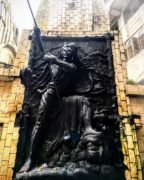
A huge statue of an angry Shiva with a spear in his hand was etched in black on the wall above the tank, and it was covered by the steam from the hot spring below. “The langar attached to the gurdwara uses water from the hot spring to cook rice and daal,” said the temple priest pointing at four vessels kept covered inside the hot water just below Shiva’s statue.
When we went around the shrine, we saw Shiva in the form of a lingam decorated with fragrant local flowers. The shrine, surprisingly, was free of crowds as it was the hot spring which attracted most of the tourists.
The local story is that Parvati lost a piece of her jewelry in the river during the divine couple’s 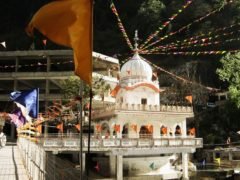 stay in Manikaran. After a long search, Shiva used his spear to bore the river and the jewelry appeared in the hot spring, and since then the spring has been spewing hot water at 83 to 90 degree centigrade, while the river water flowing outside is cold. As we recited Vishnu Sahasranama, we were joined by another family from Tamil Nadu and we began talking in Tamil. We talked of how nice it would be to have a water source such as this for our cities – Chennai and Bengaluru!
We were asked to buy rice and channa and cook it in the hot water. It took nearly 15 minutes for both to get cooked in the spring. It was a unique way of displaying our devotion to Shiva and Parvati. We remembered Sai Baba cooking in Dwarakamayi. There was bhakti, devotion, especially among the local residents and camaraderie between the Hindus and Sikhs in the area. Soon after we left the hot spring, we were led into the langar hall. We had to cover our heads, but we easily mingled with the gurdwara devotees. Though we had seen a langar on TV, this was the first time we were part of the people sitting in the langar waiting to be served hot food, straight from the hot spring.
It was a humbling experience to eat rice, daal, chapatti and khichri with everyone together. We had to put away the plates at the designated area within the langar hall, where they were being washed by volunteers. We left the langar, after this altogether different experience.
Back in Manali, we went shopping as it was our last day there. We also visited a Tibetan monastery. There was a huge moorthi of the Buddha and people stood in silence before it. In temples, we chant shlokas and mantras, and make offerings to gods, but in the gurdwara as well as in the monastery, people offer their services by keeping the place clean and by serving visitors — to me these were completely different approaches to please God. All methods work well as long as they are done with humility.
Back in our hotel room, we wondered how lucky and blessed we were to have visited spiritual places of three religions on the same day.
For the outside world, Manali is a place full of fun and frolic and attracts honeymooners; for us it was different. We returned to Bengaluru but couldn’t stop recalling the wonderfully different experiences we had of Sai Baba taking us to Parvati and Parameshwar, the gurdwara and the monastery at Manikaran.
Leave a Reply