
By: Sanjay Padia
Navaratri is a great occasion for all in Bengal. Following Vijayadashami, Sai devotees celebrate Baba’s Mahasamadhi to pay homage to the Parabrahman.
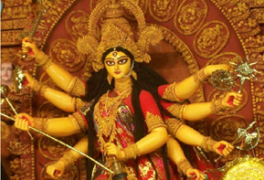
The nine nights and days of Navaratri indicate the darkness of ignorance present in us and ways to bring in the light of knowledge that will remove the darkness. Sai Baba says in the Sai Satcharita that because of ignorance, humanity is suffering. Devi, the feminine aspect of nature, is venerated during Navaratri. The first three days are dedicated to Durga, the destroyer of inertia; the next three days to Lakshmi to overcome passion and the last three days to Saraswati to embrace the pure aspect of nature. On the tenth day – onVijayadashami, celebrates the victory over all these three – tamas, rajas, and sattva. With Baba’s ‘Seemolanghan’ at the transit of Vijayadashami to Ekadashi, you are in for radiant life.
In his masterpiece ‘Life of Sai Baba’ Sri Narasimha Swamiji says, ‘Go on listening till you understand’. We have a gross body and deep within is the subtle body and our soul which is consciousness, awareness. Rakshasa in the gross form has a gross body and represents our disorganized energy. When anger, hatred, and jealousy exist, they generate disorganized energy; it makes you miserable. Whereas if you have compassion, love, caring, and silence within, as advised by Sai Baba, it is organized energy, godly energy. Disorganized energy is a demon.
Each demon in the Navaratri story represents a type of disorderliness.

In each of the thirteen chapters of Devi Mahatmyam, there are demons, namely, Madhu and Kaitabha and also Mahishasura, Chunda-Munda, Shumbha-Nishumbha. When all these demons are killed, ignorance is destroyed.
The tenth day also celebrates the defeat of Ravana by Rama. Ravana’s ten heads signify negative energies and an impure mind. Rama symbolizes Atma, the soul and Sita stands for hridaya, the heart. Therefore, listening to scriptures and performing service help to purify the mind.
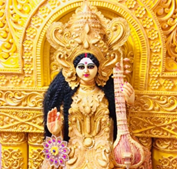 Practice ‘Nama Smaran’. Simply go on chanting ‘Sai Ram’. Mana, mind in Sanskrit, when purified with Nama Smaran, by devotion and understanding, becomes Nama. Our manaha has to become namah ‘Sri Sainathaya’.
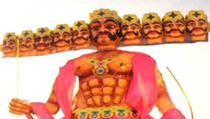 When there is no devotion and no spiritual exposure, your mind will become Ravana and it will keep going round and round in a vicious circle.
The heart is pure and loving but the impure mind is the culprit. The Dashamukhi mind represented by Ravana is destroyed during Navaratri, hence we say Asahara, destroying the ten negatives.
Lakshmana is intellect. He is always loyal to Rama which is Atma. Hanuman represents courage and intuition. He is not a monkey, but he is a different being altogether. Scriptures say that the only person who had mastered the nine systems of grammar was Hanuman. He is called Nava-vyakarana-parangata. At present, there is only one system of grammar which is the Patanjali or Panini system of grammar. We have lost all these eight systems of grammar. But the Ramayana mentions that Hanuman was the knower of all the nine systems of grammar.
With the help of Hanuman’s courage and support of Lakshmana’s intellect, Sita, the heart, is brought back to Rama – the Atma, by the destruction of Ravana – the impure mind. This is indeed the Dashahara. This is followed by Sai Baba’s Mahasamadhi day which reminds Baba close behind our thoughts.
There is Sai Rama in all of us, the consciousness, the awareness. There is Lakshmana the intellect which is also in us. There is Ravana the impure mind that is also in us. By sadhana of worshipping Lord Sainath, our mind becomes pure, then the mind unites with the soul, the ultimate destination called moksha, which is Self-realization.
Leave a Reply