
By: Sri Narasimha Swamiji
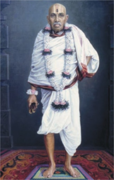 A disgraced minister in the princely state of Nanded in Maharashtra who was treated disrespectfully by the king decided to leave the king’s court and join the group of Kirthankars led by Dasganu Maharaj. In his new life of associating with a Saintly Soul like Dasganu Maharaj and devoting to Lord Sainath away from the rat race, he found peace of mind and fell in love with the kind of person he had now become. His name was Nanaji Deshmukh, and he joined us during 1936-39 while we undertook an extensive tour across Maharashtra creating devotion to Lord Sainath.
One fine day in 1937, the Nanded king realized that he missed his good minister, who he had disgraced at a whim. He decided to invite him back to join his court. To the king’s surprise, the minister-turned-Kirthankar declined to go back to his old life, and he explained to the flustered king that rather than serve once again in an uncertain career and be humiliated by the king, he likes to live a quiet life as a Kirthankar of Sai Maharaj away from politics. He added that he was no longer trapped by attachment to power and pelf, and so felt liberated, content, and at peace in Bhakti-Marg.
“But…but…,” the king protested. “I need a wise and competent man to help me conduct affairs of Nanded state. Come back.” To which the ex-minister replied that the sign of a true man of wisdom is to not be lured by power and wealth, but to live a life of contentment, dignity, and peace. Staying and working closely with the king would mean having to put up with all kinds of humiliation and suffer his bouts of anger. Fire is good if one keeps one’s distance from it; it could provide warmth and fuel, but the moment you get too close to it, you will either get burnt or fall into the fire and die. “I am done with playing politics and gauging your moods, your Majesty,” said the ex-minister. “Having realized my worth, I would rather stay away from you and your court.”
Dasganu Maharaj used the story of Nanaji Deshmukh in his Kirtan and stated that Lord Sainath, however, offers another solution in the Sai Satcharita wherein you can become wiser, content, dignified, maintain your career and self-respect and so on without having to abandon action and become a renunciate.
Lord Sainath says that no one can give up action; all of us are compelled to act while we live. But the value of renunciation — giving up the fruits of action — is hailed as the sure path to salvation. Sai Maharaj has revealed to Kaka Dixit the finer shades of difference between the terms sanyas and tyaga. Tyaga is renunciation of the fruit of action, while sanyas is renunciation of the desire in action. If the former is the cause, the latter is the effect. By practicing tyaga you become a sanyasi.
When Dixit became an ascetic in 1916, Sainath pointed out that these ordained duties are of two kinds — daily routine ones and occasional special duties. These must be done by all, but it is the attitude behind the acts that matter. One does not long for the fruit of action and acts with no habitual likes or dislikes. Also, the feeling that it is he who is doing it should be absent. 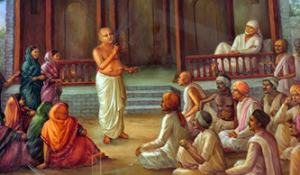 This can be achieved by giving up ownership, that is, getting rid of ego-sense.
In the Gita (chapter two, verse 47), Lord Krishna says that the right is to work only; never to its fruits, that we should exercise our right to work and do what needs to be done, without getting attached to action or its fruits.
Leave a Reply