
Templates of Activity in The Introductory Verse of SahasRaNama
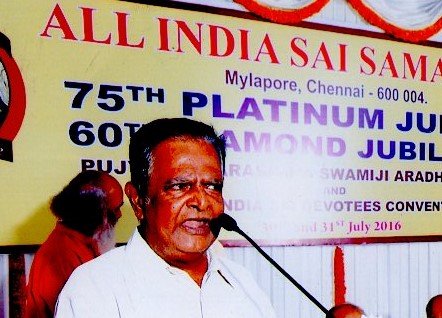
Dr. G.R. Vijayakumar
The Vishnu SahasRaNama lays down a unique template which maps out each activity in the universe through the prism of chanting one thousand names of the Lord. Even as it presents a chant structure, through which all phenomena are seen, the SahasRaNama, at another level, goes deep into the metaphysical dimension of the empirical world.The SahasRaNama begins with the word ‘VisWam’-the Universe,the Cosmos. In the Vedic language, ‘VisWam’ means ‘Brahma’-Omkara – Aum which on elaboration constitutes the Sapta Vyahritis. Vyahritis mean words. The first sounds produced whilecreating the Universe are called Vyahritis. And the seven worlds that constitute the Universe go aptly by the name of these Vyahritis – Óm Bhuhu Bhuvah Suvah Mahaha Janaha Tapaha Satyam’.
Creation involves movement, which in turn produces sound. There is no movement without sound. So, creation and sound,though they mean different, are really one and inseparable. Thus, the whole creation, the universe, is contained in Sapta Vyahritis which constitute the first word of SahasRaNama, ‘VisWam’
‘Óm VisWam VishNuh VaShatKaRaHa BhuTaBhavYa BhaVath PraBhuh
BhuTaKrit BhuTaBhriTh BhaVah BhuTatMa BhuTaBhaVaNah’
The whole of the SahasRaNama is the elaboration of this word ‘VisWam’. From the first word, the SahasRaNama explains in so many words and expressions what the Brahman is. In the next eight words of the opening verse, the conception of the word ‘VisWam’ has been explained in a nutshell. In other words, the entire summary of the SahasRaNama has been explained in the opening verse. Therefore, in these first nine words the entire concept of SahasRaNama has been abridged.
‘VisWam’ is described as the Universe. ‘VishNuh’ is omnipresent and all-pervading. For how long has he been omnipresent and all-pervading is answered in ‘BhuTa BhavYa BhaVath PraBhuh’ – which indicates that He is the Lord of the Past, the Present and the Future. ‘BhuTa Krit’ means He is the Creator of all beings. He does not stop with creation, but He sustains and protects them as ‘BhuTa BhriTh’ and as ‘BhaVah’ protects them lovingly. He is the Self of Beings ‘BhuTatMa’. Sai Baba has confirmed in Sai Satcharitra that He exists in every being as Ántaryamin. Ultimately as ‘BhuTa BhaVaNah’ He IS THE Generator and Evolver of all beings.
Thus, the whole philosophy taught and practiced by Sai Baba is compressed in this first shloka or verse which is comprised of nine words. He constitutes the entire Universe. He is all-pervading. He is everywhere, and everything is under His sweet control. He is the Master of the Past, the Present and the Future, having neither a beginning nor an end. He is the Creator,Sustainer, Evolver and Lover of all beings. He is the Soul of the existence and nothing exists Except Him. He resides in every being. Every Sai devotee recites this condensed philosophy in the first shloka of Vishnu SahasRaNama as he pays obeisance to Sai Baba.
Sai Baba told his devotees: “I see myself everywhere. There is no place without me. There is nothing else but me, my eyes are in every place, keeping a watch on my devotees on the evil and the good. No one can escape” (Sai Satcharitra, Chapter14, Ovi 48).
This ‘VisWam’ is central to the understanding of the laws of the universe and recitation of Vishnu SahasRaNama is an ‘Yajna’ for all Sai devotees.
‘YajNa’ means sacrificial offering where oblations of ‘Havis’ like ghee are offered into the sacred fire. ‘YajNa’ means to adore or worship. However, the word ‘YajNaGuhYam’ (982) in SahasRaNama means a deed performed without desire for the result.
The sacrificial yajNa in present time may be substituted by dharma. No greater tribute has been paid to ‘Pitru Seva’ than that paid by Rama while addressing Seetha before embarking on ‘VanaVasa’. While the sentiment of obeisance to father, mother,teacher and guest is stressed, the word ‘Anna’ is inserted to ultimately indicate the importance of ‘Annadan’.

Sri Narasimha Swamiji
Sri Narasimha Swamiji visited Mysore in 1940s for Sai Pravchar. Sri Rallapalli Ananthakrishna Sharma was Telugu Pandit in Maharaja’s durbar and was greatly influenced by Sri Narasimha Swamiji’s greatness (incidentally Sharma’s son, Prof. R.A. Phani Shayi was my teacher at National College, Bengaluru in mid-sixties) and informed the Maharaja. The Maharaja sent an invitation through the Diwan, Mirza Ismail to Sri Narasimha Swamiji to visit the palace and have lunch. Swamiji accepted the invitation and called on the Maharaja. When lunch was served, he mixed everything served on the leaf into a big ball,took out three fistfuls and kept it aside. Swamiji fed the major portion to cows in the ‘Goshala’ and took only the three fistfuls for himself! The Maharaja was greatly impressed.
The Maharaja, Sri Jaya Chamaraja Wodeyer interacted with Sri Narasimha Swamiji on ‘Divya Nama Smaran’ and other philosophical questions. He asked Swamiji five questions. His first question, “Do you know where mortals go to after death?” Swamiji answered that for him Sai Baba as God Almighty pervades the entire universe and mortals are absorbed into this ‘perfect consciousness’. The second question, “Do you know from where people come when they are reborn?” Swamiji answered that they will arise from the same God Sai Baba who pervades the universe. The third question, “What are the paths through which the soul ascends?” Swamiji offered two paths – ‘Bhakti Marga’ by propitiating the Almighty through ‘Divya Nama Smaran’ – chanting Vishnu SahasRaNama and ‘Karma yoga’- doing everything without any expectation.
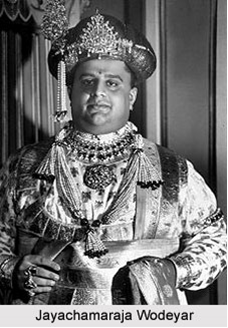
The Maharaja’s last question was, the significance of offering five oblations in an yajNa. Sri Narasimha Swamiji answered this question quoting the templates from Vishnu SahasRaNama. The first template is that ‘VisWam’ the entire universe is fire and all existence follow this cycle of fire. The next altar is of clouds, where the fuel is the air from which arises rain. The third altar is earth where the fuel is time, from which arises food. The fourth altar is man,where the fuel is food, from which arises the seed. The fifth altar is woman, to whom the seed is offered as oblation, and from which arises the fetus.
Sri Narasimha Swamiji viewed ‘VisWam’ the creation at all levels as a sort of yajNa, sacrifice, where all activity is interconnected. The birth of a child is not
just a simple outcome between man and woman. Swamiji stated that a child is conceived from every cell of the universe. The notion of ‘my child’ and ‘your child’ is a misunderstanding of the basic laws of the universe. Swamiji told the Maharaja that the inter connectedness of the universe and contemplation of this principle of five templates, is true meditation into the essence of things.
‘Óm VisWam VishNuh VaShatKaRaHa BhuTaBhavYa BhaVath PraBhuh
BhuTaKrit BhuTaBhriTh BhaVah BhuTatMa BhuTaBhaVaNah’
It prompts us to look beyond the obvious, to delve deep into the fundamentals of whatever we see, hear or touch. This introductory verse of SahasRaNama reminds us of ‘Tat Tvam Asi’ that each of us comes from, and are that Self, the Athman,nothing less. We are all the part Sai Parabrahman.
Lord Sainath has groomed his devotees to view life on the spiritual discipline of the emptying out of the sense of self, of the ego. When a profound dilemma arises, let us remember Lord Sainath close behind our thoughts and pray to him to grant us emancipation from the cycle of births and deaths.
Attachment is what causes problems and you need to guard yourself against it. I may have all basic requirements like bed,pillow, blanket, mosquito-net but I am not attached to them. I can enjoy a comfortable life; I can take it or leave it.
Sai Baba says that attachment causes suffering. Relieving suffering by giving up everything is not the right way, you do not have to renounce everything and go away, although it is easy to do so
Sri Narasimha Swamiji in his masterpiece ‘The Life of Sai Baba’ has stated that everyone of us is ‘paripurna’ or totally fulfilled,completely satisfied. For some reason you may not know it. Ignorance of your fullness causes an imaginary void.
Sai Baba accepts you as his own and gives knowledge of your fullness. Once you experience fullness, you will be independent of the world. Sai Baba also prescribes the technique of obtaining the world so that you are comfortable at any stage in life. In short, devotion to Sai Baba enables you to gain the world and not be bound to it.
Sai Baba’s grace having created and supported the notion of our own and the other, also has taught us to overcome the unhelpful side of this tendency. So how is it that we, as Sai devotees, end up doing absolutely the opposite? If such approaches and attitudes pain us or make us unhappy, how very important it is to re-commit to learning our lesson in ‘total surrender’ to Sai Baba and doing our best to live at his will! He removes the ignorance that conceals Him within yourself. Lust, anger, pride, jealousy, attachment and delusion form the basis of ignorance. Removal of these six passions enables us to experience ‘Self’ within ourselves and within everyone else. It leads us to experience that blissful oneness with all –‘AhamBrahmasMi’
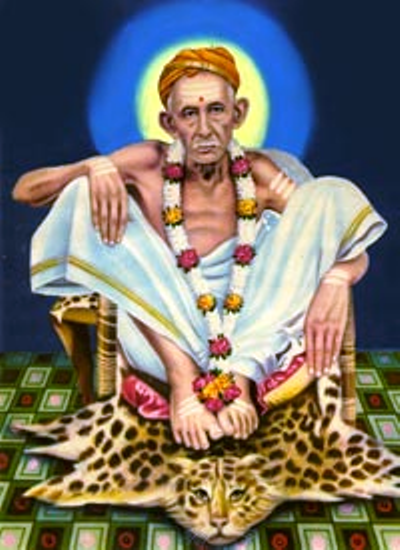
Shri Siddharuda Swamy
Here is an instance from the life of Sri Narasimha Swamiji. He was staying in Siddharuda Ashram in Hubballi of Karnataka in 1929. Siddharuda Swamiji asked his pupils how they could tell when the night had ended, and the day had begun.“Could it be”, asked one of the inmates, “when you can see an animal in the distance and tell whether it is a sheep or a dog?” “No” answered Siddharuda Swamijii. “Is it when you can look at a tree in the distance and tell whether it is a banyan tree or bilva tree?” Again, Siddharuda Swamiji answered “No”. The impatient pupils were looking forward to what reply Sri Narasimha Swamiji would give.
Sri Narasimha Swamiji gave an epoch-making reply: “It is when you can look on the face of any man or woman and see that it is your sister or brother. Because if you
cannot see this, it is still night.”
By: Dr. G.R. Vijayakumar
Leave a Reply