
By: Seetha Vijayakumar
Sainath Parabrahman has advised us to love everyone, particularly our neighbors. Why should I love my neighbor like I love myself? The answer is simple: Because it’s the most sensible thing to do. Loving your neighbor is the first and best choice among the three choices you possess. The first choice is love. The second is hate, and the third is indifference.
 Let us examine each choice, beginning with the third choice. Perhaps you don’t want to love your neighbor because he is bad, yet you wouldn’t want to hate him because you are a good person, and you would rather avoid negative emotions. So, you are indifferent to your neighbor. But according to Lord Sainath, indifference or apathy is a cold emotion. Apathy is as negative as hatred. The line between hatred and apathy is very fine. If you meet your neighbor on the street and you ignore him, it doesn’t seem like a decent thing to do. The second choice – hatred – will harm you as much as it hurts your neighbor, which leaves you with the first and the best option – to love your neighbor.
Honestly, loving an irksome neighbor is not as hard as it seems. In Sai Satcharita, we read that it simply means respecting the person and thinking of his needs and desires as much as you would your own. You won’t be able to love yourself until you first love your neighbor. Whether we like it or not, a major part of our life will always center on that of our neighbors. Ask yourself some questions, and you’ll see from the answers how important your neighbor is for your peace and happiness. You can’t just stop loving your immediate neighbor. You’ve got to love your neighbor’s neighbor, too, and so on. The circle of love gets wider, subsuming differences of community, state, nation, and continents – encompassing the whole universe and beyond.
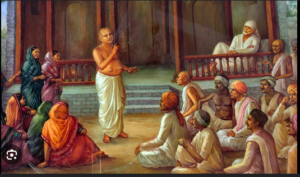
Your heart is so big and so full of love; its capacity to love is infinite; it’s divine. Inversely, your heart’s capacity to hate is limited. Try applying Sainath’s Golden Rule of Infinite Love to hate, and you’ll find yourself shattered. That’s because you don’t have a limitless capacity to hate like you have to love. For love gives you joy and power and victory, and hate brings in sorrow and powerlessness and defeat. When Das Ganu Maharaj performed ‘Kirtans,’ the audience could visualize Sainath Parabrahman. When a devotee sought ‘Udi’ from Nana Saheb Chandorkar for his wife suffering from an illness, Nana did not have it at that moment. Nana took some mud from the ground and prayed to Sai Maharaj, and relief was instantaneous, which is proof that Sainath is close behind our thoughts.
 Sainath Parabrahman’s dictum in Sai Satcharita and the Bible verses on loving your neighbor echo in the Bhagavad Gita. Krishna says: ‘Those devotees are very dear to Me who are free from malice toward all living beings, who are friendly, and compassionate. They are free from attachment to possessions and egotism, maintaining balance in happiness and distress, and ever-forgiving. They are ever content, steadily united with Me in devotion, self-controlled, of firm resolve, and dedicated to Me in mind and intellect, 12:13-14.’ The Gita verses mean that those devotees who believe in Krishna know that every person and other living entities are part of Him. Therefore, such devotees love all people, irrespective of any differences, real or perceived.
Leave a Reply