
By: Seetha Vijayakumar

Manik Prabhu Maharaj is a contemporary of Sai Baba and a few references to him are noted in Sai Satcharita. He is regarded as an incarnation of Dattatreya by the people of Datta Sampraday.
On our way from Bidar to Gulbarga, my husband stopped at Maniknagar, for ‘Datta Prasad’ as I was complaining of my distaste for Garlic in the food served at the Medical College guest house where we stayed!
Prabhu’s philosophy, the “Sakalamata Siddhanta” is similar to Sai Baba and rests on the principles of Advaita Vedanta. Prabhu strongly advocated the essential oneness of all religions. Prabhu’s Muslim Devotees revered him as an incarnation of Mehboob Subhani whereas his Lingayat devotees saw him as a form of Basavanna. Prabhu composed numerous Bhajans and Padas in various languages such as Marathi, Kannada, Hindi, Urdu, and Sanskrit.
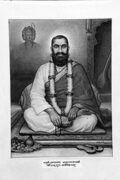
Sai Baba of Shirdi, Swami Samarth of Akkalkot, Bramhachaitanya of Gondavale, and many other contemporary saints are believed to have visited Maniknagar to interact with Prabhu on matters of deep spiritual wisdom.
Manik Prabhu was born to Manohar Naik and Baya Devi, a Deshastha Rigvedi Brahmin couple, on 22nd December 1817 (Margashirsha Pournima – Datta Jayanti, in his maternal grandparent’s house at Ladwanti near Basavakalyan (now in the Bidar district of Karnataka).
He did not have schooling. Later Prabhu traveled on foot as a wandering Yogi across the length and breadth of the country covering all places of religious importance such as Varanasi, Haridwar, Mathura, Badri, Puri, Dwarka, Girnar, Tirupati, and Rameshwaram. Some of his Muslim Devotees believe that he visited the Shrine of Mehboob Subhani at Baghdad. After completing his spiritual journey across the country, Prabhu finally decided to settle on the banks of the rivulets Viraja and Guruganga in the year 1845 which later came to be known as Maniknagar (a place near Humnabad in Bidar District of Karnataka)
Prabhu stayed in a simple hut and ate only the ‘Madhukari Bhiksha’ (alms) which his shishyas (disciples) would bring from the nearby villages. Usually, he dressed in very simple clothes and established the GAADI (spiritual seat) of Lord Dattatreya in the very hut where he used to reside. This Gaadi is a symbol of ‘Nirguna Bramha’. The unique thing about it was that he did not place an 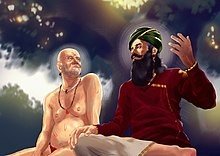 idol or spiritual icon on the GAADI and instead decided to keep it empty. The idea behind it was that his devotees could visualize the PARABRAMHA (the supreme reality), in whatever form they liked and worship him accordingly.
Prabhu Darbar
The name and fame of Manik Prabhu spread quickly like a wildfire and people  of all religions, sects and communities started flocking to Maniknagar. Prabhu used to hold a gathering every day called DARBAR where thousands of people visited him and sought his blessings. Prabhu guided his devotees in spiritual matters and even helped them overcome their material difficulties.
Stories of his miracles and eyewitness accounts, which bear testimony to how he brought succor to the distressed and the sorrowing, to the afflicted and the wronged, who, ardently and with deep faith and devotion sought his spiritual intervention are available. He never claimed credit for any such incident and always said that it is ‘Datta Prabhu’s Leela’. He is also believed to have given Darshan to a devotee in the Divine form of Goddess Tulaja Bhavani and accepted the devotee’s offerings. Many such stories are compiled in the official biography of Shri Manik Prabhu by Ganesh Raghunath Kulkarni.
Visits of Spiritual personalities
Shri Swami Samarth is also believed to have visited Prabhu before settling at Akkalkot. According to Shri Manik Prabhu Charitra, Swami Maharaj stayed at Maniknagar for six long months. Shri Manik Prabhu and Shri Swami Samarth used to sit under the holy Audumbar tree.
Shri Sai Baba of Shirdi visited Prabhu as a young Fakeer may be in subtle form around 1860. According to the tale, Prabhu was sitting in his Darbar when Sai Baba arrived. Sai Baba asked Prabhu to fill his Lota. Prabhu instructed Tatya Saheb, his brother who was sitting beside him, to fill the lota. Tatya tried to fill the lota while speaking to someone else. Even after putting hundreds of coins, the lota would not fill. Tatya was astonished and gave the Lota to Prabhu. Prabhu put 5 Dates and some flowers in it. The Lota filled immediately. Sai Baba took the dates and flowers and said that this was enough for him.
Sai Baba at Dwarakamayi told his devotees that he was returning from Manik Prabhu and poured back the coins which were many times more than the original coins put in the Lota by Tatya Saheb.
Shri Bramha Chaitanya of Gondavale also visited Prabhu at Maniknagar. The Shankaracharya of Sringeri at the time, Jagadguru Ugra Narasimha Bharati Swamiji paid a visit to Maniknagar during Prabhu’s time. Prabhu welcomed the Shankaracharya with due honors and the Shankaracharya appreciated Prabhu’s noble work.
Sanjivani Mahasamadhi
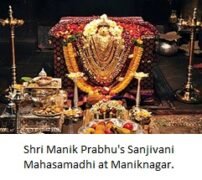
In 1865, Prabhu felt that it was time for him to take Mahasamadhi. The annual Datta Jayanti Utsav had already begun.
Then he sat in the pit of the Samadhi and asked his aides to close the pit from all sides. Prabhu attained Sanjivani Samadhi, a state of meditative blissful consciousness. Eyewitness accounts suggest that Prabhu left his physical body by the yogic way of Samadhi on the evening of Ekadashi around 5 PM. Prabhu’s devotees believe that he is sitting in the Sanjeevan Samadhi and answering their prayers even to this day.
Maniknagar is the only Datta-Peetha where a Guru-Parampara exists for the spiritual guidance of the devotees.

The Sampradaya is called SAKALAMATA as it involves and assimilates all sects and creeds. It is not at all antagonistic to them but only means to supplement them.
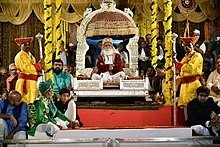 People believe that Manik Prabhu was a reincarnation of Lord Dattatreya. The Manik Prabhu Temple is located on the confluence of two holy rivulets Viraja and Guru Ganga. The village of Maniknagar is built around this temple and is located on the high ground slopes.
Leave a Reply