
By: Sri Radhakrishna Swamiji
Almost every human activity is directed towards happiness. Though we perform many functions for ourselves, our family, and society, we do it all for the sake of our happiness. Ultimately, all actions, spiritual or material, are traced back to one’s urge for happiness. But the concept of happiness differs from one person to another. This leads us to ask, ‘What constitutes happiness which is everlasting and common to all? What is the source of happiness?’ Adi Shankara said, “Let us light the lamp inside and find the treasure of happiness there.”
The individual believes that happiness-causing elements such as family relations, position, and possession all exist outside of him. The desire for wealth, for example, can be misleading. A millionaire from Nagpur, Balasaheb Booty came to Sai Baba in quest of spirituality. He met Baba at Dwarakamayi. Looking at his serene and pleasant face, the impressed Booty asked: “What makes you so happy?” Baba said, “I am happy not because of what I have but because of what I am.”
In his Vairagya Shatakam, Saint Bhartrihari says: “Even if wealth stays with us for some time, it would certainly leave us one day.” Then, what difference does it make if we discard it now or later? When we renounce wealth voluntarily, such self-control gives us infinite bliss. Whatever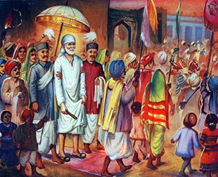 ‘Dakshina’ money Sai Baba collected, he distributed to one and all. He collected hundreds of rupees but ultimately remained a fakir. He used to say that “God is a friend of the poor”
Sri Narasimha Swamiji said: “Shiva made over all his possessions to Vishnu, wandered in jungles and cemeteries and lived on food received from begging. For Shiva, non-possession is higher in the scale of happiness than possession.”
The modern individual may not agree. He would say he cannot think on the lines of renunciation because he is part of a common endeavor for the progress of humanity. The Bhagwad Gita does not deny this. It says, “Continue doing the duties assigned to you. You need not renounce anything of value. What you need to renounce is the ‘I’ notion (ego). Discard the ‘sense of doership’ which is done with a personal motivation.

Happiness is not something that is acquired anew. It is already there. It is ignorance that overshadows happiness. The moment jnana, Self-knowledge, dawns, it leads to real happiness. What needs to be done is to remove the obstacle.
Everyone loves his parents, his God, relations, and friends, but his first love is towards himself. He who knows his real Self remains happy because Self-knowledge is Brahmananda — “I am Brahman, Nityananda, and Satchitananda” — bliss arising out of truth and consciousness.
HAPPINESS IS A STATE BEYOND THE MIND WHICH DISTRACTS THE INDIVIDUAL FROM THE PATH OF TRUTH.