
Hanuman inspires humility courage and strength
In those days, there was no regular worship of Baba except accepting garlands brought by the devotees. But later on, Baba started allowing devotees to apply sandal paste to his forehead and offer him flowers. Dada Kelkar did pooja and applied sandal paste.
On that day, Nanavalli dressed like Hanuman along with his friends all dressed like monkeys were dancing in front of Baba. Everybody was amused.
Suddenly Baba asked Dada Kelkar to take me to Hanuman Mandir and narrate details of Hanuman’s humility and courage.
We took Pooja materials and went to Hanuman Mandir. After worship, we sat down and as guided by Baba, Dada Kelkar narrated the story of Hanuman’s humility.
When Valmiki completed his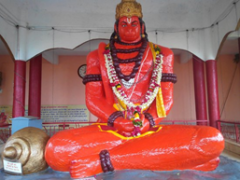 Ramayana, Narada said, ‘It is good, but Hanuman’s is better’. A perplexed Valmiki set out to find Hanuman and reached Kadali Vana, the grove of plantains, where he found Hanuman’s Ramayana inscribed on seven broad leaves of a banana tree. He read it and found it to be perfect. He started to
 cry. ‘Is it so bad?’ asked Hanuman. ‘No, it is so good, that after reading your Ramayana no one will read my Ramayana,’ replied Valmiki.
Without hesitation, Hanuman simply tore up the seven banana leaves, saying ‘Now no one will ever read Hanuman’s Ramayana.’ A stunned Valmiki asked Hanuman why he had destroyed his beautiful work. Hanuman said, ‘You seem to need your Ramayana more than I need mine. You wrote so that the world remembers Valmiki; I wrote so that I remember Ram. Ram is an indelible part of me; he is in my heart, soul, body and, mind.’
Valmiki’s writing was inspired by ambition whereas Hanuman’s inspiration was his pure devotion and affection for Ram. That’s why Hanuman’s Ramayana read so much better; it was his way of expressing his deep love for Ram. Hanuman did this without the expectation that his exquisitely written Ramayana will make him famous. That Hanuman destroyed what he had written shows his utter humility and lack of interest in self-promotion or glory. He was just a genuine bhakta of Ram who happened to express himself in writing, and the perfection of that expression and his willingness to also tear up the writing, reveals that he was full of equanimity.
Hanuman needed no validation from the outside; nor did he wish the focus to be on him. He just did his karma, spontaneously, with no expectations. He was just content with something that was well done. Whether it would make him famous or not, was of no consideration.
Dada Kelkar told one more version of the same story. One story says Hanuman engraved his Ramayana with his nails on rocks in the Himalayas where he had gone to do penance. And Valmiki was taking his Ramayana to Shiva for his blessings and that was when the Valmiki-Hanuman encounter took place, and Hanuman is said to have simply picked up the engraved stones and dumped them into the ocean.

Stories related to Hanuman exalt the virtues of selflessness, love, faith, devotion, humility, self-esteem, inner strength, and self-confidence besides the need to cultivate the ability to act without worrying about the fruit of that action. Further Dada Kelkar told me that this is what inspired Tulsidas to write of Hanuman in the following words, in his Ramcharitmanas: ‘Greater than Ram is the servant of Ram.’
Hanuman is renowned for his courage and strength, both physical and mental. This is why Tulsidas composed forty verses in praise of Hanuman, called the ‘Hanuman Chalisa’ that is recited by all young and old, who invoke Hanuman’s grace, to overcome fear and become strong.
By then Nana Saheb Chandorkar also came to Hanuman Mandir and joined our discussion. Nana Saheb added One verse on Hanuman which describes him as the bestower of the eight Siddhis, the supernatural powers named Anima, Garima, Mahima, Laghima, Prapti, Prakamya, Isitva and, Vasitva. And the nine Nidhis — divine treasures named Mahapadma, Padma, Sankha, Makara, Kacchapa, Mukunda, Kunda, Nila, and Kharva. This boon is granted to Hanuman by Mother Sita, daughter of Janaka.’
We went back to Masjid and bowed to Sai Maharaj as we visualized Hanuman in him.
Leave a Reply