
By: Dinesh Chikkaballapur
Reading about the Stoics, the similarities struck me — with what Krishna spelled out in the Bhagavad Gita to Arjuna and the principles by which the Sai Baba lived and taught. When a despondent Arjuna hesitates to fight against his kinsmen, Krishna reminds him that to a balanced person, this is a duty to be performed to uphold dharma. To become a ‘sthitaprajna’, an even-minded person, Arjuna would have to embrace qualities like Titeeksha, endurance, and sama, equanimity.
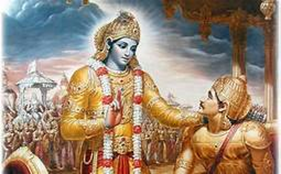 In 2:14-15, Krishna says to Arjuna that the senses contact objects which cause heat and cold, pleasure and pain that have beginning and end. These are all impermanent; they need to be endured bravely and every verse in the epic Sai Satcharita reverberates with this concept. Titeeksha is endurance, something that the Stoics, starting from Zeno and Chrysippus right down to Epictetus and Marcus Aurelius had all advocated and practiced in their own lives. The Stoics, whether privileged or from humble backgrounds, led normal lives in the material world while practicing and promoting a philosophy steeped in endurance, frugality, and equanimity.
The earliest Stoic, Zeno, who died 262 years before the coming of Christ, expressed the four virtues of Stoicism thus: courage, temperance, justice, and wisdom.
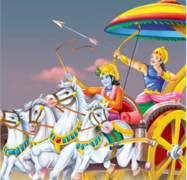 Krishna explains to Arjuna that the one who remains unaffected by pleasure and pain, who regards them as the same, is a steady, balanced person, one who is full of sama, that is, equanimity. Sai Baba is our Atma – ‘Antaryamin’ and such a one can be regarded as immortal because he is cognizant of the fact that the Self, the Absolute, is changeless, indestructible, and eternal. The Self does not identify itself with the mortal body and through it, with the world outside. Therefore, it remains peaceful within.
Krishna tells Arjuna in verse 2:21 of the Gita that the extremely delicate aspect of the art of living is to play our part in the world as though it was a reality while never forgetting the ultimate reality, which appears, through our mistaken perception, as the world. He implies that to stay detached while carrying out one’s worldly duties is the essence of a person who has overcome ignorance.
Looking at Arjuna on the battlefield at Kurukshetra, one is reminded that all Stoics suffered; ‘They hung out in the marketplace. They too, fairly or unfairly, faced arrest,” write the authors of a book that chronicles the lives of the Stoics that begins with the tragic sinking of Zeno’s ship that brought him misfortune, egging him to turn to philosophy; Sai Baba himself was considered a mad fakir, Antipater the ethicist, Porcia the iron woman, Seneca the striver and many other Stoics right up to Marcus Aurelius, the philosopher-king. Aurelius said, “There is no role so well suited to philosophy as the one you happen to be in right now”. Perhaps the implied role of an emperor; it could also mean that of a parent, spouse, one who has received bad news, one who is rich, one who has gone bankrupt, and so on. Epictetus was a slave who got free at the age of thirty when he chose to become a Stoic philosopher. One could dare say that a lot of Stoic philosophy echoes the Gita philosophy.
Leave a Reply